Blog / Industry Guides
Choosing Dispatch & Route Software for a Singapore Fleet
13 Jun 2026 · AppTech System
For any Singapore business running vehicles — delivery, transport, field service — the gap between a good and a bad day usually comes down to dispatch. Manual route planning and status-by-phone-call burn fuel, overtime, and patience. And the cost is real: diesel in Singapore sat around S$3.8 to S$3.9 a litre in mid-2026, far above the world average, so every wasted kilometre shows up on the fuel bill. This is a neutral buyer’s guide — what the software actually does, the tools Singapore fleets really use, how grants change the maths, and the few cases where a custom build beats anything off the shelf.
What does dispatch & route-optimisation software actually do?
Dispatch and route-optimisation software turns order lists into efficient, trackable runs. It builds multi-stop routes in seconds, pushes jobs to driver apps, tracks every vehicle live, captures electronic proof of delivery (ePOD), and keeps customers informed with automated ETAs. The goal is fewer kilometres, less overtime, and far fewer “where is my order?” calls. The features that move the needle:
- Route optimisation — multi-stop, multi-vehicle routes against time windows and capacity, in seconds not hours, with live re-optimisation as jobs change.
- Auto-dispatch — routes and jobs pushed straight to driver mobile apps.
- Live tracking — real-time view of every vehicle and job, so the office stops calling drivers.
- Electronic proof of delivery — photos, notes, barcode scans, and e-signatures captured at the doorstep.
- Customer ETAs — automated updates that cut “where is my order?” calls.
- Fleet analytics — utilisation, on-time rate, and cost per delivery.
Demand makes this tooling worth the effort. Singapore’s last-mile delivery market was worth roughly US$500 million in 2025 (Mordor Intelligence), and parcel volumes spike sharply around mega-sales like 9.9, when carriers such as SingPost release extra peak capacity. If your planning is manual, peak season is exactly when it breaks.
How much does route optimisation actually save?
The savings come from three places: fuel, overtime, and disputes. The clearest evidence is UPS’s ORION engine, which the operations-research body INFORMS reports saves roughly 100 million miles and about 10 million gallons of fuel a year, worth hundreds of millions in annual cost. That is enterprise scale, but the mechanism is the same for a ten-vehicle fleet.
Translate it to a Singapore SME. Suppose ten vans each cover 120 km a day. Trimming even 8 to 10 per cent of distance through tighter routing removes hundreds of kilometres a week. At diesel around S$3.8 to S$3.9 a litre (GlobalPetrolPrices, 01 Jun 2026), that is a real, recurring line-item saving — before you count the overtime you avoid when drivers finish their runs earlier.
The third saving is disputes. Electronic proof of delivery replaces “I never received it” arguments with a timestamped photo, signature and GPS pin. Vendors report digital ePOD can cut delivery disputes by up to around 25 per cent; treat that as a directional vendor figure rather than an audited statistic, but the logic holds. Fewer disputes mean faster payment and less admin chasing.
Why fuel matters more here: Singapore diesel sat near S$3.89 a litre on 01 Jun 2026 against a world average closer to US$1.51 — and in March 2026 diesel briefly overtook 95-octane petrol (Mothership). High, volatile fuel prices are precisely why route efficiency pays back faster in a Singapore fleet than in most markets.
What Singapore context changes the buying decision?
Two local factors reshape the maths: grants and data rules. On grants, the Productivity Solutions Grant (PSG) funds up to 50 per cent of qualifying costs, capped at S$30,000 per company per financial year (EnterpriseSG). Fleet management and last-mile routing tools appear in the GoBusiness PSG directory, so the right off-the-shelf tool can be half-funded.
To qualify for PSG, a company must be registered and operating in Singapore, have at least 30 per cent local equity, and a group turnover of S$100 million or under, or 200 employees or fewer. One rule trips people up: you must not pay or place any deposit before applying. Fleet management and last-mile routing solutions are listed in the GoBusiness PSG directory from pre-approved vendors — for example, Cartrack is a PSG-approved fleet vendor. For larger custom transformation, the Enterprise Development Grant (EDG) supports up to 50 per cent of qualifying project costs.
Timing matters too. EnterpriseSG has flagged a new EDGE grant launching in the second half of 2026, with EDG, MRA and PSG remaining available until then. If you are mid-procurement, check which scheme is live before you commit, and read our PSG vs EDG guide for which grant fits an off-the-shelf tool versus a custom build.
The second factor is data governance under the PDPA. Every ePOD captures personal data: recipient names, signatures, doorstep photos and GPS coordinates. That makes hosting location, retention period and access control real procurement questions, not extras. Some tools retain ePODs for years by default, so confirm you can set retention and audit who views records. If you handle other sensitive workflows, our PDPA readiness check is a quick starting point.
There is also a fit caveat. Generic overseas tools often mis-map Singapore addressing, postal codes and tight delivery windows — and several leading tools are Singapore-founded, which is a genuine differentiator. The national direction is clear too: the LTA Land Transport Industry Digital Plan actively nudges logistics SMEs toward digital operations.
Which dispatch tools do Singapore fleets actually use?
Below are tools Singapore fleets genuinely use, grouped by who they suit. This is orientation, not a ranking, and prices change — so treat the “pricing model” column as the commercial shape, not a quote. The strongest “used in Singapore” picks are the locally founded or PSG-relevant ones (Detrack, Cartrack, Yojee, Zyllem), with global platforms listed as comparators.
| Tool | Best for | Pricing model |
|---|---|---|
| Detrack | SMEs wanting ePOD, live tracking and route planning with a simple driver app | Per-driver monthly subscription |
| Cartrack | Fleets prioritising GPS telematics, driver behaviour and fuel control; grant-funded buyers | Hardware per vehicle + monthly per-vehicle SaaS |
| Yojee | Freight forwarders and 3PLs digitising multi-leg transport with partner-fleet visibility | Subscription / enterprise (quote-based) |
| Zyllem | Companies coordinating owned and partner fleets across South-East Asia in one dashboard | Enterprise / quote-based |
| Onfleet | Self-serve last-mile dispatch with real-time re-routing | Tiered SaaS (per task / route volume) |
| Locus | Larger operations needing SLA-driven routing and multi-carrier orchestration | Enterprise / quote-based |
Inclusion is informational, not an endorsement; “best for” reflects each vendor’s positioning, and pricing is described as a model only — confirm current capabilities, Singapore fit and PSG status with each vendor before deciding.
A note on the local leaders. Detrack is a Singapore-founded delivery-tracking SaaS, operating since 2014 and used in 50-plus countries, that captures ePOD and re-optimises routes as jobs change; it can retain ePODs for up to five years, which is exactly the retention setting your PDPA review should examine. Zyllem and Yojee both started in the region, which usually means cleaner handling of local addressing and partner-fleet workflows than a generic import.
How should you evaluate the options?
A good shortlist is decided by fit, not feature counts. Roughly 60 per cent of buyer regret traces back to adoption and integration, not missing features — so weight the driver app and your existing systems heavily. In our experience helping fleets scope these projects, the tool that drivers actually use beats the tool with the longest brochure every time. Work through this checklist:
- Singapore fit — local addressing, postal codes, traffic patterns and tight time windows handled cleanly.
- Route-optimisation depth — multi-stop, multi-vehicle, time windows, capacity and live re-optimisation, not just A-to-B mapping.
- Driver app usability — adoption decides whether the data survives; simplicity wins.
- ePOD completeness — photos, e-signature, barcode scan, mandatory-field rules and a configurable retention period.
- Live tracking and customer ETAs — to cut “where is my order?” calls.
- Integrations — orders, CRM and accounting/invoicing, including InvoiceNow-readiness for e-invoicing.
- Analytics — utilisation, on-time percentage and cost per delivery.
- PDPA and data governance — where data is hosted, retention controls and access logs.
- Grant eligibility and scalability — is the vendor PSG-approved, and does it hold up at double the fleet size? Total first-year cost = hardware + subscription + implementation.
One thing the brochures rarely surface: total first-year cost is not the subscription. Add hardware (for telematics-based tools), implementation and training, then judge value. A purely software tool billed per-driver and a telematics tool billed per-vehicle plus hardware look similar on a monthly line but diverge sharply once setup is in. If routing is your core need, our route optimisation overview breaks down where the gains come from.
When should you build custom instead of buying?
For most fleets, an off-the-shelf tool is the right call, and you should not build what you can buy. Standard delivery and last-mile operations run perfectly well on a product. The cases where custom (or extending a platform) wins are specific, and they share one trait: your dispatch logic is your competitive edge, not a commodity.
Custom tends to win when you have complex or unusual constraints no product models well, specialised job types (chauffeured transport, cold-chain, multi-leg freight, mixed delivery-and-service runs), or a need for deep integration where dispatch must sit inside your order, billing and partner systems rather than beside them. Generic tools force costly workarounds in exactly these situations, and the workarounds quietly become the cost.
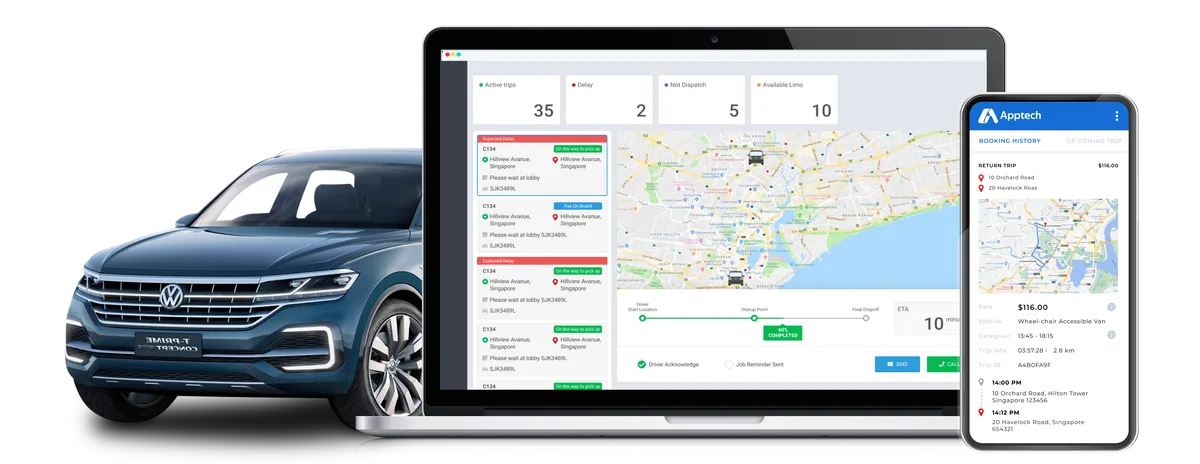
That’s the work we do. We build dispatch and route systems for operations whose logic doesn’t fit a box — see our logistics & dispatch systems solution, and our limousine dispatch case study for a real example of custom paying off. If you’re weighing the decision more broadly, our guides on choosing a software company and local vs offshore development walk through the trade-offs. Related operations software — like field service management and inventory management — often needs to share the same data, which is another reason integration depth matters.
How we help fleets
Whether you buy or build, the goal is the same: fewer wasted kilometres, less overtime, and a doorstep record you can stand behind. Explore our transport & logistics page and our DispatchOps platform, or if standard tools can’t capture your operation, talk to us about a tailored build.
Disclaimer: AppTech System is a software development vendor, not a government agency or accredited grant adviser. Grant schemes (PSG, EDG, the upcoming EDGE), their eligibility criteria and funding levels are governed by EnterpriseSG and administered via GoBusiness, and are subject to change. PDPA obligations are governed by the PDPC. Fuel prices are volatile and quoted as of the stated date. Product mentions are informational, not endorsements, and capabilities, pricing and grant status should be verified with each vendor and the official directories before any decision.
About AppTech System — AppTech System is a Singapore custom-software team and the people behind the Automiq and BooknGo platforms, building web, mobile, AI and enterprise software for businesses in regulated industries. Talk to us.
Running a fleet that’s outgrown spreadsheets and phone calls?
See DispatchOps