Blog / Industry Guides
Field Service Management Software for Singapore Businesses
13 Jun 2026 · AppTech System
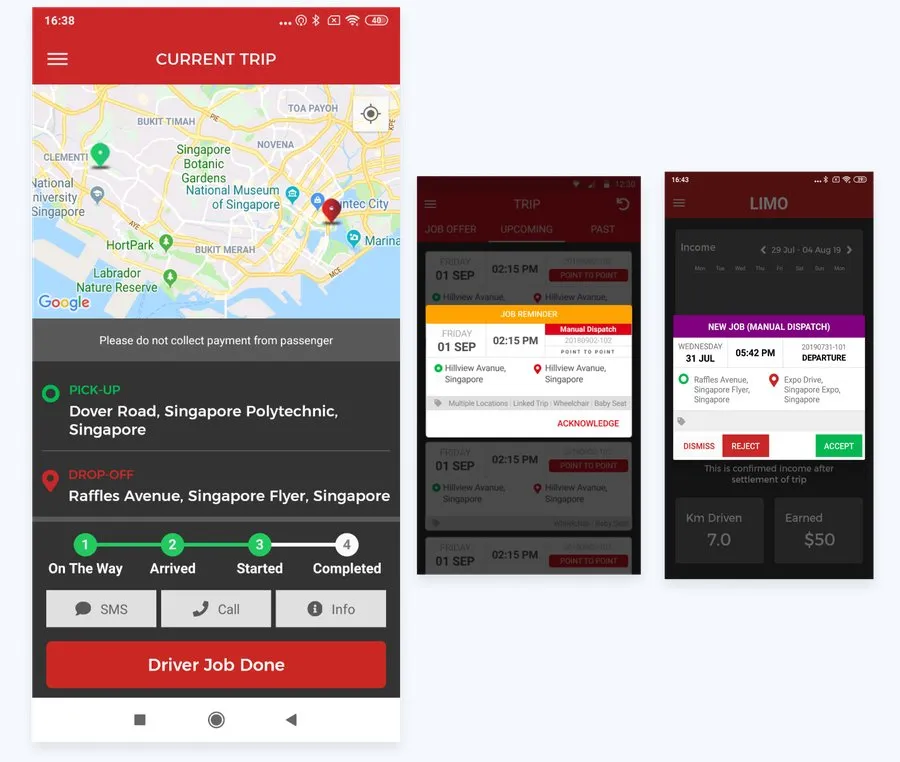
If your business sends technicians, installers, or cleaners to customer sites — aircon, pest control, maintenance, repairs — the office-to-field gap is where time and money leak. Jobs assigned by phone, status unknown until someone calls in, paperwork that arrives days later. Field service management (FSM) software closes that gap. This is a neutral buyer’s guide: what good FSM software does, the Singapore rules that change your shortlist, the tools local firms actually use, and the few cases where building custom beats anything off the shelf.
What does field service management software actually do?
Field service management software runs the full job lifecycle from booking to billing, replacing whiteboards, WhatsApp groups and paper job sheets. It is core infrastructure for trade businesses, and adoption is now mainstream: Singapore’s digital economy reached 18.6% of GDP in 2023, up from 14.9% in 2019 (IMDA, 2025). The core capabilities a good FSM tool delivers:
- Job scheduling & dispatch — assign jobs by skill, availability, and location, and push them to the field instantly instead of calling around.
- Technician mobile app — the day’s jobs, customer details, history, and checklists in the technician’s pocket, ideally working offline.
- Live status & tracking — the office sees progress and location in real time, without ringing every technician for an update.
- Proof of work — photos, checklists, parts used, and a customer e-signature, timestamped on site for disputes and warranty.
- Invoicing on completion — billing triggered the moment a job closes, cutting the lag between work done and cash collected.
- Customer notifications — appointment confirmations and ETA updates that quietly kill the “where’s my technician?” phone calls.
The thread running through all six is the same: one source of truth for a job, shared live between the office and the field. Scheduling and dispatch decide who goes where; the mobile app puts that plan in the technician’s hand; live status closes the loop back to the office. When those three connect cleanly, the “where is my technician” call disappears and so does the days-late paperwork.
If you are still running jobs off a wall planner and a shared spreadsheet, that pain is the signal to move. Our guide on signs you’ve outgrown spreadsheets covers the tipping point in more detail.
What Singapore rules change your FSM shortlist?
Three Singapore-specific factors should narrow your shortlist before features do: grant eligibility, e-invoicing readiness, and data protection. Most global comparison articles ignore all three. Get them right and you avoid both wasted spend and a forced re-buy. This is where a local lens matters more than a longer feature checklist, so weigh each one against your trade and growth plans.
PSG funding (and which FSM tools qualify)
The Productivity Solutions Grant (PSG) funds up to 50% of eligible costs, capped at S$30,000 per company, for pre-approved digital solutions vetted by Enterprise Singapore and IMDA (Enterprise Singapore). The catch: only pre-approved tools qualify, not FSM software in general. A worked example is Genic Teams, a Singapore-based FSM platform (scheduling, dispatch, GPS, invoicing) listed as a pre-approved solution under IMDA’s SMEs Go Digital programme. Before you bank on the grant, confirm your chosen tool is on the official directory, and remember no payment should reach the vendor before approval.
InvoiceNow and the GST e-invoicing mandate
If your FSM tool bills on completion, that invoicing has to be future-proof. Singapore is rolling out the GST InvoiceNow Requirement, the national Peppol-based e-invoicing network: voluntary from 1 May 2025, then mandatory for newly-incorporated voluntary GST registrants from 1 November 2025, and for all new voluntary GST registrants from 1 April 2026 (IRAS). It then phases in by annual-supply threshold, reaching essentially all GST-registered businesses by 2031 (Avalara, 2026). The buyer takeaway: your tool should be Peppol/PINT-SG ready, or integrate cleanly with accounting software that is. Our InvoiceNow guide explains the timeline in plain terms.
PDPA and your technicians’ phones
Every job photo, customer signature and address your technician captures is personal data under the Personal Data Protection Act. That brings duties around consent, protection, retention and breach notification. If a breach is notifiable, you must tell the PDPC as soon as practicable and no later than 3 calendar days; a breach affecting 500 or more individuals counts as significant scale (PDPC). So ask any vendor where data is hosted, what the access controls are, and how a breach is handled. Our guide to handling customer data securely walks through the obligations for SMEs.
Why do proof of work and parts tracking matter so much?
Proof of work and parts tracking are where field businesses recover the most leaked margin, because they turn “the technician says it’s done” into evidence and tie every part used back to a billable job. Get these two right and you cut disputes, warranty arguments and stock shrinkage at once. They are easy to overlook in a demo, yet they quietly decide whether a job is profitable.
Proof of work that holds up
On-site capture is your defence when a customer disputes a job weeks later. Good FSM tools collect timestamped photos, completed checklists, parts used and a customer e-signature before the technician leaves. For aircon servicing or pest control especially, a before-and-after photo plus a signed completion record settles most arguments and supports warranty claims. It also feeds clean records into any PDPA-compliant system, since those photos and signatures are personal data you now hold.
Parts, van stock and reorder triggers
If your trade carries parts, untracked van stock is silent margin loss. Stronger FSM platforms log parts consumed per job, current van stock and reorder triggers, so a depleted item prompts a restock instead of a missed second visit. Tools like Synchroteam lean into this. If inventory is genuinely central to your operation, our inventory management software guide digs deeper into stock control for Singapore businesses, including how it connects to job costing.
Which FSM tools do Singapore businesses actually use?
Most service firms can start on an off-the-shelf platform; the trick is matching the tool to your trade and size rather than chasing the longest feature list. The table below orients you by who each tool suits best. Lead with Genic Teams if PSG eligibility and local support matter; the others cover small trades through to project-heavy operations. Pricing models are noted, but published dollar figures vary by edition and promotion, so treat them as direction, not quotes.
| Tool | Best for | Pricing model |
|---|---|---|
| Genic Teams | SG SMEs wanting a PSG-claimable local tool with local support | Subscription, per-user / plan tiers |
| ServiceM8 | Small trade teams wanting a polished mobile job-card app | Per-user/month + low job-capped starter |
| Jobber | Growing service SMEs wanting quoting, CRM and reminders in one | Tiered monthly (per-user beyond base) |
| Simpro | Larger, project-based operations (maintenance contracts, multi-stage jobs) | Tailored per-user, monthly or annual |
| Synchroteam | Teams needing strong parts/inventory tracking on mobile | Per-user subscription |
| Workiz | Established operations scaling technicians and job volume | Per-user / plan tiers |
| Klipboard | Service businesses with recurring or planned-maintenance contracts | Subscription tiers |
Inclusion is informational, not an endorsement; “best for” reflects each vendor’s positioning. Pricing models are indicative only — confirm current capabilities, PSG status and pricing with each vendor before deciding. Sources: IMDA SMEs Go Digital listing, SoftwareAdvice and Simpro.
The honest framing: these off-the-shelf tools cover standard service operations well. Genic Teams is the natural starting point for a Singapore firm that wants grant support and local help. ServiceM8 and Jobber suit small trade teams; Simpro and Workiz handle larger or project-based work; Synchroteam and Klipboard shine where parts tracking or planned maintenance dominate. Custom only enters the picture when your job logic is your competitive edge.
How should you evaluate FSM software before buying?
The make-or-break factor is whether technicians will actually use the mobile app: if it is clunky, the data dies and you are back to phone calls. That single risk should anchor your whole evaluation. Work through the checklist below with your real workflows and your real team in mind, and trial the shortlist on actual jobs rather than relying on a sales demo.
- Technician mobile-app usability — will techs use it on site, on their own phones, offline in a basement carpark? This is the number-one failure point.
- Scheduling & dispatch fit — assign by skill, availability and location; handle reschedules, no-shows and recurring jobs without friction.
- Proof-of-work capture — photos, checklists, parts used and a customer e-signature, timestamped on site for warranty and disputes.
- Singapore addressing & routing — postal codes, building and unit handling, and realistic local travel windows across a dense island.
- Invoicing + InvoiceNow readiness — bills on completion and can feed Peppol/PINT-SG e-invoicing for your GST phase.
- Accounting & systems integration — connects to Xero, QuickBooks or your stack rather than becoming another silo.
- Parts & inventory — track stock used per job, van stock and reorder triggers if your trade is parts-heavy.
- PDPA & data hosting — where customer data lives, access controls, breach process and DPO support.
- PSG eligibility — is the tool on the IMDA pre-approved list so you can claim up to 50%?
- Scalability & total cost — does the per-user model stay affordable at double the headcount, and can you export and leave if you outgrow it?
How is FSM software priced, and where do costs creep?
Vendors rarely publish full prices, but the models are predictable: most FSM tools sell per-user, per-month, some with a low job-capped starter tier and others with tailored enterprise plans (SoftwareAdvice, 2026). The hidden trap is per-user creep: a plan that looks cheap with five technicians can sting at fifteen. Model your monthly bill at double your current headcount before signing, and confirm what is included versus billed as an add-on.
Watch for setup and onboarding fees, charges for extra modules (advanced reporting, a customer portal, inventory), and any per-transaction cost on payments or e-invoicing. And read the export terms: if leaving means losing your job history and customer records, that lock-in is a real cost. For custom-build budgeting, our guide on app development cost in Singapore sets out the trade-offs. Always get a written quote covering per-seat fees, setup and extras.
When should you build a custom field system instead?
For most aircon, pest control, cleaning and maintenance firms, an off-the-shelf FSM tool is the right call, and you should not build what you can buy. Custom (or extending a platform) wins in specific cases: unusual job logic that no product models, work spanning multiple entities or branches, deep integration with systems you already run, or routing and vehicles being central enough that generic FSM falls short.
That last case is where field service shades into logistics. If multi-stop technician routing across the island is your daily reality, our route optimisation system and DispatchOps platform are built for vehicle-heavy operations; our dispatch and route software guide compares the options. Worth noting on funding: the PSG funds pre-approved off-the-shelf tools, while the Enterprise Development Grant (EDG) can support genuinely custom software — a useful contrast when you weigh build against buy. See our PSG vs EDG guide and EDG support page.
We build job dispatch and tracking systems tailored to how field businesses actually operate. See our field services page for what that looks like, and our guide on custom vs off-the-shelf for how to make the call.
Disclaimer: AppTech System is a software development vendor, not a government agency or accredited grant adviser. National programmes and rules — the PSG, SMEs Go Digital, the GST InvoiceNow Requirement and PDPA obligations — are governed by Enterprise Singapore, IMDA, IRAS and the PDPC, and are subject to change. Product mentions are informational, not endorsements; grant eligibility, pricing and capabilities should be verified with each vendor and against the official government directories before any decision.
About AppTech System — AppTech System is a Singapore custom-software team and the people behind the Automiq and BooknGo platforms, building web, mobile, AI and enterprise software for businesses in regulated industries. Talk to us.
Office and field still out of sync?
Talk to Us