

Web Application Development
Web Application Development in Singapore
Turn everyday business tasks into one connected web app
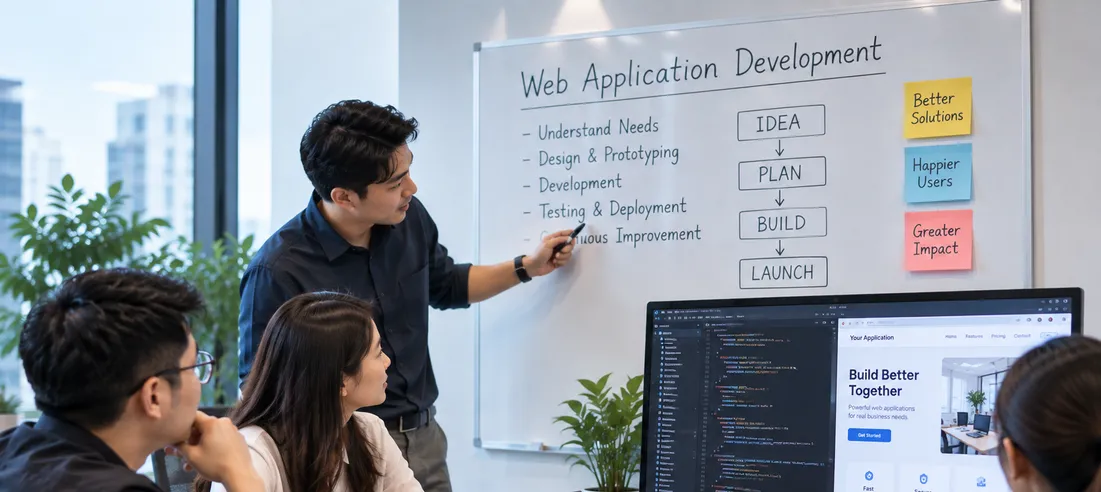
Give customers a simpler way to book, order and manage their accounts. Give your team the tools to process requests, track work and make decisions without chasing spreadsheets.
AppTech System provides custom web application development for Singapore businesses. Our web application developers turn business requirements into software your customers and staff can use through a web browser. We design and build customer portals, internal business tools and SaaS platforms around the people who use them and the systems you already run.
What is web development?
Web development is the process of building websites and applications that you access through a web browser, such as Chrome or Safari. It can range from a simple static website that displays company information to a complex web application where users log in, make bookings, process orders or manage business operations.
Web application development focuses on the interactive end of that range. For example, a company website may explain your services, while a customer portal lets people book those services, make payments and track their requests.
When your workflow needs more than a spreadsheet
A request arrives by email. Someone copies it into a spreadsheet. Another team checks the details, then sends an update through a separate tool. As the volume grows, so do the delays and missed handovers.
A custom web application brings those steps together. Users enter information once, see what needs attention and follow a defined process from start to finish.
Our web application development services are designed for businesses that need to:
- Replace repetitive data entry with connected workflows.
- Give customers secure access to their own information.
- Track requests, bookings and approvals in one place.
- Bring data from different systems into useful dashboards.
- Launch a software product with its own users, subscriptions and administration.
The starting point is your business problem. We help define what the application needs to do, who it serves and which features should come first.
Custom web application development services
Customer and partner portals
Make it easier for customers, suppliers and partners to work with you. A web portal can support account access, document uploads, appointment bookings, order tracking and service requests.
Your staff gain a clearer record of each interaction, while users can complete routine tasks without waiting for an email reply.
Internal business applications
Build a shared workspace for operations, administration and service delivery. Replace disconnected forms and spreadsheets with structured records, assigned tasks and clear status updates.
Examples include job management, resource scheduling, request handling and approval workflows. Access permissions help each team see the information relevant to its responsibilities.
Dashboards and reporting
Bring operational data into a view your managers can use. Track workload, outstanding requests and performance across teams or locations.
We define the data sources and reporting rules with you so that each dashboard answers a practical question. Your team spends less time assembling reports and more time acting on the information.
SaaS application development
Turn a product idea into a web-based platform. Plan the customer experience alongside administration, user roles, subscriptions and reporting.
For multi-tenant applications, we define how accounts, access and customer data are separated. Start with an MVP that tests the essential product experience, then extend it as you learn from users.
API integration and connected systems
Connect your web app with accounting software, CRM platforms, payment gateways and other business tools where suitable interfaces are available.
Integration planning covers more than moving data. We agree which system owns each record, when updates happen and how exceptions are handled, helping reduce duplicate entries and conflicting information.
Legacy application modernisation
Improve an existing application that has become difficult to use, maintain or extend. We review the current system, identify dependencies and plan which parts to retain, connect or replace.
A phased approach allows you to prioritise the workflows that matter most while preparing users and data for the transition.
A web development process built around your users
1. Understand the workflow
We review your objectives, user groups, current tools and operational constraints. Together, we define the first release, key integrations and what successful delivery should look like.
2. UI/UX design and the user experience
Review the screens and user journeys before development progresses. We consider navigation, forms, mobile layouts and the steps people need to complete a task.
This is where unclear requirements become concrete decisions your team can assess.
3. Develop and review
The application takes shape in working increments. Regular demonstrations let you review functionality and resolve questions while changes are easier to make.
Front end development, backend development and database design work together to support the agreed business logic.
4. Integrate and test
We test core journeys, user permissions, data validation and connections to external services. Your team reviews the application against real business scenarios through user acceptance testing.
Performance and device testing are scoped around the expected usage and supported environments.
5. Launch and support
Prepare for deployment with agreed hosting, backups, monitoring and handover requirements. After launch, maintenance and future improvements can be planned around usage, feedback and business priorities.
Web app development services: technology and data management
Our published web development stack includes React, TypeScript, Node.js, PostgreSQL and AWS. The final architecture depends on your functionality, integrations, expected demand and maintenance requirements.
Responsive design helps users work across desktop, tablet and mobile browsers. Role-based access, input validation and appropriate encryption are considered during system design.
If you need offline access, push notifications or device features, we can assess whether a progressive web app or a separate mobile application is the better fit.
A software development company focused on your workflow
Experience building and running software
AppTech develops its own products, including Automiq, BooknGo and DispatchOps. That product perspective informs how we approach administration, workflows and the ongoing operation of business software.
A focus on practical business outcomes
A long feature list is not the same as a useful application. We help prioritise the functions that remove a bottleneck, improve a customer journey or make information easier to act on.
A connected approach to development
Your web application needs to fit into the way your business operates. We consider integrations, data ownership and user responsibilities alongside the interface.
A plan for what happens after launch
Applications evolve. We discuss documentation, support and future development so you can plan beyond the first release.
How to compare web development companies
Choosing a web app development company starts with how well the team understands your business requirements. Ask to see relevant work, discuss who will make technical decisions and check what the proposal includes.
Useful questions for a development company include:
- How will you turn our business goals into an agreed scope?
- Who is responsible for project management and day-to-day communication?
- How will the user interface be reviewed with our target users?
- What is included in testing, deployment and ongoing maintenance services?
- How will we access documentation and plan future development?
The best web app development partner for your project should make assumptions and trade-offs clear. Compare the proposed approach, responsibilities and support arrangements alongside the price.
Examples of web applications for business teams
Custom web applications are useful wherever people need to share information and complete repeatable tasks. An education centre might provide a portal where students manage bookings and staff track enrolments. A service business might need job allocation, customer updates and a management dashboard.
A distributor could connect a customer ordering portal to enterprise systems, allowing staff to check orders against operational records. For payment integration, the scope should include transaction status, failed payments and reconciliation needs.
Each example starts with a different workflow. Custom web app development lets the user experience and data management follow that workflow, with features prioritised for your business.
Let's plan your web application
Tell us where work slows down and what you want customers or staff to do more easily. We will help turn those requirements into a clear development scope.
Book a Web Application Consultation
Prefer to speak? Call +65 6871 8798.
Start a Conversation
Tell us what you need built
A consultant replies within one business day with a straight answer on fit, cost and timeline. No sales deck.
- Free scoping call, no obligation
- Honest view on build vs buy
- EDGE Grant eligibility checked for you
Prefer to talk? +65 6871 8798
Frequently Asked Questions
Questions about web application development
01What do web application developers do?
Web application developers build the interface, business logic, databases and integrations that make browser-based software work. The development process includes planning, implementation, testing and deployment, with ongoing support agreed for the application.
02How do web development services differ from website development services?
Website development services often focus on a public web presence, content and enquiry journeys. Web development services for an application also cover user accounts, data processing and business rules. Your project may combine both, with a public site connected to a secure portal.
03What is the difference between a website and a web application?
A website primarily publishes information. A web application lets users perform tasks, such as submitting requests, managing bookings or updating records. Many businesses need both: a public website for enquiries and a web app for customer or internal operations.
04How much does a custom web application cost?
The cost depends on the number of workflows, user roles, integrations and screens, as well as data migration and hosting requirements. Share your priorities and current process with us so we can define a scope and provide a project-specific quotation.
05How long does web application development take?
The timeline depends on complexity, feedback and integration requirements. A focused first release is easier to plan than a platform covering every department. Discovery establishes the delivery milestones and identifies dependencies that may affect launch.
06Can a web app connect to our existing software?
Yes, where the existing software provides a suitable API or another supported method of exchanging data. We assess access, data formats, usage limits and security requirements before confirming an integration.
07Will the application work on mobile devices?
Responsive web applications can adapt to different screen sizes and run in a mobile browser. If users need extensive offline functionality or specialised device access, we assess those requirements separately.
08Can you improve an existing web application?
We can assess an existing application's code, architecture and dependencies to determine a practical route forward. The recommendation may involve targeted improvements, new integrations or a phased rebuild.
09What should we prepare before speaking with you?
Bring an outline of the problem, examples of the current workflow, the tools you use and the people who will use the application. A formal specification is helpful but not essential for the initial discussion.
Didn't find your question? Ask us directly and a consultant will reply within one business day.
See what web application development could look like in your business
Free workflow assessment: we map your current operations and show you exactly what to automate first.